

Echo Chambers Expand Faster Than Strategy
When dissent disappears, execution gets louder, risk gets quieter, and leadership loses the signal it needs to steer.


Most executive teams do not become echo chambers because people suddenly turn passive. They become echo chambers because the cost of candor becomes clearer than the value of speaking.
That is when the damage starts.
Not with a public breakdown. Not with a dramatic resignation. Not with one explosive meeting. It starts quietly. A few people stop pushing back. Others notice which opinions are welcome and which ones create friction. Meetings become smoother, but the signal quality drops. The room feels aligned, yet the business becomes less informed. Execution continues, but it becomes blind execution. Teams keep moving, but now they are moving around distortion, not reality.
From there, the losses compound. Trust breaks quietly. Indifference replaces ownership. Innovation suffocates because fear kills contribution before it starts. Talent walks because strong people do not stay where they have to shrink to survive.
Real leaders understand something many executives still miss. Culture is not proven by how calm the room feels. It is proven by whether truth can survive proximity to power.
Echo chambers are an execution failure, not just a culture problem
The common mistake is to treat echo chambers as a soft issue. Leaders frame them as engagement, communication, or morale concerns. Those matter, but that framing is incomplete. An echo chamber is an execution defect. It means the organization is no longer converting frontline reality, expert judgment, and cross-functional tension into better decisions.
Why this matters:
That matters because leadership teams do not fail only from bad intent. They fail when they lose access to contradiction. In regulated and high-stakes environments, that loss is expensive. Quality risks go unchallenged. Commercial assumptions go untested. Operational constraints get minimized. Timelines become theater. Leaders believe they are moving with clarity when they are actually moving with filtered information.
The cost is not only strategic drift. It is slower escalation, weaker tradeoff decisions, false confidence in metrics, and a growing gap between executive narrative and operating truth.
What to do:
Stop asking whether your team is aligned. Start asking whether your system produces challenge early enough to improve the decision. In practice, that means every major review needs a mechanism for dissent, not just time for updates. Assign someone to test assumptions. Require one identified risk to every proposal. Ask what would make the current plan fail. If nobody can answer, you do not have confidence. You have compliance theater.
Decision rule:
If a meeting produces agreement without surfacing tension, assumptions, or downside exposure, it is probably underperforming as a decision forum.
Trust rarely breaks in conflict first. It breaks in observation
Most leaders think trust breaks when people are attacked, ignored, or publicly embarrassed. That certainly happens. But in many organizations, trust breaks earlier and more quietly. It breaks when people observe that candor does not change outcomes.
That is the real turning point.
An executive raises a concern and gets dismissed. A plant leader flags a risk and the timeline remains unchanged. A quality leader surfaces system exposure and the room pivots back to optics. A middle manager watches a favored voice get rewarded while a dissenting voice gets labeled difficult. People learn quickly. They update their behavior. They do not stop caring. They stop investing their credibility in rooms where honesty has no return.
That is when indifference starts replacing ownership. At first it looks like professionalism. People nod. They comply. They deliver status. But psychologically they have stepped back. They no longer see the system as responsive enough to deserve discretionary effort.
Why this matters:
This matters because once ownership becomes conditional, execution weakens everywhere. Issues come later. Warnings get softened. Escalations become selective. People manage exposure instead of solving problems. The organization becomes polite on the surface and brittle underneath.
Real leaders intervene before cynicism hardens.
They do not just say, “I want honest feedback.” They prove that honest feedback has consequences in the system. When someone raises a hard point, the leader slows down, examines it, and shows what changes as a result. Even when the final decision stays the same, the reasoning must reflect the challenge. People need evidence that dissent affects the process.
What to do:
In your next three leadership meetings, visibly track one thing: what changed because someone challenged the initial view. If the answer is nothing, your trust system is weaker than your engagement survey suggests.
Innovation suffocates long before the pipeline shows it
Most organizations talk about innovation as a capability issue. They look at funding, talent, process, or market sensing. Those matter, but innovation fails earlier in the interpersonal system. It dies when contribution starts to feel risky.
Fear does not have to be dramatic to be effective. It can show up as interruption, impatience, performative certainty, selective attention, or rewarding only polished ideas from senior voices. People learn to self-edit before they contribute. They stop bringing unfinished thinking, emerging risks, or unconventional angles. The organization still runs ideation sessions, strategy workshops, and improvement events, but the real range of thinking narrows.
Why this matters:
It matters because innovation is not just about generating new ideas. It is about preserving enough psychological and operational space for challenge, experiment, and recalibration. If people are punished for being early, imperfect, or inconvenient, the system will not innovate. It will decorate.
Leaders who want real innovation need to separate evaluation from exploration. Do not let every new idea enter the room under immediate executive scrutiny. Build protected pathways where concepts can be shaped before they are judged. Create forums where junior experts, technical operators, and cross-functional voices can surface patterns without needing full certainty. Reward useful contribution, not just polished presentation.
What to do:
The operating mechanism: Run two distinct forums:
A discovery forum for surfacing signals, ideas, and risks
A decision forum for resource commitment and prioritization
When leaders mix those into one room, they accidentally train caution. People stop thinking out loud because every thought feels like a vote.
Talent does not usually leave first because of pay. It leaves because of contraction
Strong people can tolerate pressure, ambiguity, and stretch. What they do not tolerate for long is contraction. They do not stay where curiosity is punished, where their judgment is minimized, or where survival requires shrinking their voice.
This is especially true of your best mid-level leaders, technical specialists, and emerging executives. They are often the first to recognize when the culture has shifted from challenge to choreography. They see when the meetings are performative, when the decisions are pre-closed, when the metrics are being managed for appearance, and when certain truths are no longer welcome in the room. They may stay for a while. But internally, they begin exiting before they physically leave.
Why this matters:
Because talent loss is not only a staffing problem. It is a signal-quality problem. The people who walk are often the people with the strongest pattern recognition, the highest standards, and the lowest tolerance for institutional dishonesty. When they leave, they take more than capacity. They take friction, conscience, and early warning.
Real leaders do not wait for attrition data to tell them something is wrong. They look for signs of contraction.
Are strong people getting quieter?
Are your best operators becoming more transactional?
Are technically credible leaders avoiding the room where “real decisions” happen?
That is not a personality issue. It is usually a climate issue.
What to do:
Ask your highest-value people a harder question than “Are you happy here?”
Ask:
Where do you feel you have to self-censor?
What truths are hardest to say upward?
Where is the organization choosing comfort over clarity?
What part of your judgment is underused here?
Those questions reveal whether your culture is expanding people or shrinking them.
What real leaders do is design dissent into the operating system
Real leaders do not rely on personality or goodwill to keep challenge alive. They build governance that makes candor operational.
That is the shift many companies need. They treat dissent as a character trait instead of a design choice. Then they act surprised when challenge becomes uneven, political, or personality-dependent. In reality, dissent has to be institutionalized the same way accountability is. It needs structure, timing, and legitimacy.
Why this matters:
This matters because strong cultures are not cultures without tension. They are cultures where tension is metabolized productively. The leader’s job is not to remove discomfort from decision-making. It is to make sure discomfort is linked to better judgment, not personal risk.
What to do:
That means leadership has to be visible in a few specific ways. Leaders must avoid pre-closing major decisions with a trusted inner circle before the room convenes. They must invite challenge before they state a preference when possible. They must separate disloyalty from disagreement. And they must show the discipline to examine contrary evidence without punishing the person who brought it.
This is where governance and culture meet. A healthy leadership system has review cadence, escalation pathways, decision rights, and proof requirements that keep truth moving. It does not depend on bravery alone.
Practical decision rule:
Never close a significant decision until three things are visible:
The strongest argument in favor
The strongest argument against
The risk if the team is wrong
If only the first one is present, you are not leading a decision process. You are managing endorsement.
The SIGNAL Framework
A practical way to detect and reverse echo-chamber dynamics.
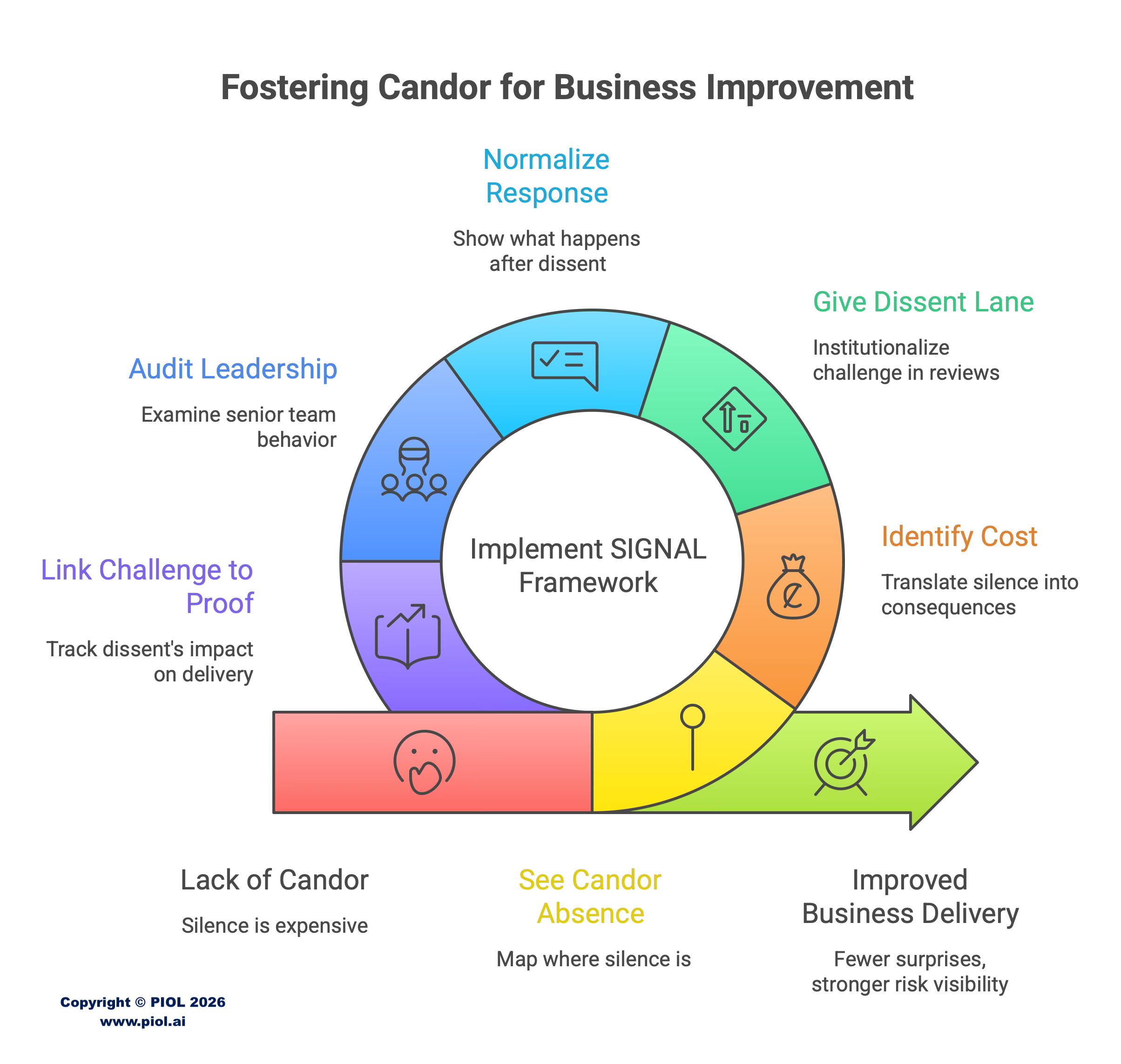
S I G N A L
See where candor is absent
Map the meetings, functions, and relationships where people are least likely to challenge. Do not guess. Identify the rooms where silence is most expensive.
Identify the cost of filtered truth
Translate silence into business consequences. Missed risks. Delayed escalation. Weak cross-functional decisions. Talent contraction. Slower innovation. Make the cost visible.
Give dissent a formal lane
Institutionalize challenge. Use red-team roles, pre-mortems, risk rounds, and assumption testing in major reviews. Do not leave candor to personality.
Normalize visible response
When someone raises a hard point, show what happens next. What changed? What got tested? What was escalated? People trust systems that demonstrate consequence.
Audit leadership behavior
Examine the senior team. Who interrupts? Who pre-closes? Who gets protected? Who gets ignored? Echo chambers are often taught by executive micro-behavior, not official values.
Link challenge to execution proof
Track whether dissent improves delivery. Better decisions should show up in fewer surprises, cleaner escalations, stronger risk visibility, and more credible follow-through.
This framework works because it moves the issue from emotion to operating design. It gives leaders a way to diagnose the climate and correct it without reducing everything to personality.
Leadership Meeting Candor Scorecard
Use this at the end of key leadership meetings.
Candor Scorecard
Score each item from 1 to 5.
Decision quality
Did we surface at least one serious counterargument?
Did we identify what could make this decision fail?
Did we test assumptions instead of repeating preferences?
Behavior quality
Did senior leaders make space before signaling their own view?
Were dissenting voices examined fairly rather than defended against?
Did anyone visibly self-censor or withdraw?
Execution quality
Did challenge produce a change in plan, timing, owner, or mitigation?
Are risks now clearer than they were at the start of the meeting?
Did we leave with named accountability, not just shared concern?
Signal quality
Did the room get more honest as the discussion progressed?
Would a junior expert feel safer speaking at the end of this meeting than at the start?
How to use it
Review the score monthly across your top operating forums. Do not use it as a culture artifact. Use it as an execution integrity measure. Low scores indicate that decision quality is being distorted upstream.
A Better Executive Review Agenda
Most leadership reviews unintentionally suppress challenge because they prioritize updates over decisions.
Suggested agenda
What changed since last review?
Focus on facts, not narrative.
Where is the plan under pressure?
Require each leader to identify one pressure point.
What are we not seeing clearly enough?
Invite cross-functional challenge before solutions.
What decision is required today?
Be explicit. No faux discussion.
What risk needs escalation?
Separate local issues from enterprise issues.
What changed because of the discussion?
Make the effect of candor visible.
This structure reduces the drift from reporting to real execution governance.
If you only do one thing
Add a formal dissent round to every major decision meeting.
Track what changed because someone challenged the initial view.
Watch your strongest people for signs of contraction, not just turnover.
Objections
“We do not have time for this. We need speed.”
You do not save time by suppressing dissent. You borrow time from later. The bill shows up as rework, avoidable risk, weak adoption, slow escalation, and talent loss. The fastest organizations are not the ones with the least friction. They are the ones with the shortest distance between truth and decision.
“This will not work here. Our environment is too tough, too regulated, or too political.”
That is exactly where it matters most. In high-stakes environments, filtered truth is more dangerous, not less. Regulation, operational complexity, and tight timelines increase the need for early challenge. Strong governance is not softer leadership. It is disciplined leadership. It converts discomfort into decision quality before risk hardens into consequence.
Close
Echo chambers do not form because organizations have too many difficult people. They form because the system quietly teaches people which truths are safe and which truths are costly. Once that lesson spreads, the business loses more than candor. It loses signal, ownership, innovation, and the kind of talent that keeps leadership honest.
Real leaders do something different. They design environments where disagreement strengthens execution instead of threatening status. They understand that trust is not built by keeping the room calm. It is built by proving that truth can enter the room and survive.
If you are leading a business through complexity, growth, compliance pressure, or transformation, this is not a soft skill issue. It is an operating system issue.
That is the work. Build the kind of leadership rhythm where challenge improves traction, not careers.
About PIOL
We translate complexity into signal, helping leaders see what is changing, what it means, and where attention is required before risk compounds or opportunity passes.
If you’re new to PIOL – Practical Intelligence for Organizational Leadership, you can follow for free to get future issues or paid to expanded views for actionable guidance.
The PIOL Platforms
PIOL Radar™ Intelligence and risk monitoring for faster, better-informed decisions.
PIOL CertPath™ Guided certification readiness from gap to audit-ready.
PIOL StrategyOS™ Strategy-to-execution discipline for leadership teams.
PIOL Offer2Close™ Deal execution from accepted offer to clean close.
Visit piol.ai to learn more.